

The demand for Paint Protection Film (PPF) has grown rapidly over the past few years. As more vehicle owners invest in luxury cars, electric vehicles (EVs), and premium paint finishes, protecting the exterior has become a priority. Today, PPF is no longer reserved for only supercars. It is also increasingly common on daily-driven vehicles that owners want to keep in showroom condition.
For car wash shop owners, detailing centres, and PPF installers, this growing market also presents a significant business opportunity. Customers who invest thousands of ringgit in PPF are more likely to return regularly for maintenance services, provided they understand the importance of proper aftercare.
One of the most effective ways to maintain Paint Protection Film is by combining safe washing techniques with a professional water coating after every maintenance wash.
In this article, we’ll explore the different types of PPF, explain how each performs, discuss why water coating plays a crucial role in PPF maintenance, and why Nanolab Water Coating is an excellent solution for professional car wash and detailing businesses.
Why Understanding Different Types of PPF Matters
Many vehicle owners assume all PPF products are identical.
In reality, the market mainly consists of three different material categories:
- PVC PPF
- TPH PPF
- TPU PPF
Each material offers different levels of:
- Durability
- Flexibility
- Chemical resistance
- UV resistance
- Self-healing capability
- Lifespan.
PVC Paint Protection Film (PVC PPF)
PVC (Polyvinyl Chloride) was one of the earliest materials used for automotive protective films.
Advantages
- Lowest installation cost
- Basic paint protection
- Suitable for temporary applications
Limitations
Compared with newer technologies, PVC PPF has several disadvantages:
- Lower flexibility
- Limited resistance to yellowing
- Shorter lifespan
- More likely to become brittle over time
- No true self-healing capability
PVC films are generally considered an entry-level option and are less suitable for long-term protection in Malaysia’s hot and humid climate.
TPH Paint Protection Film (TPH PPF)
TPH (Thermoplastic Hybrid or Thermoplastic Polyolefin Hybrid, depending on the manufacturer) was introduced as a more affordable alternative to premium TPU films.
Advantages
- Better flexibility than PVC
- Improved appearance
- Lower cost than TPU
- Suitable for budget-conscious vehicle owners
Limitations
Although TPH performs better than PVC, it still has compromises:
- Lower durability
- Reduced self-healing performance
- Lower resistance to UV aging
- Shorter service life
For customers looking for mid-range protection, TPH may be sufficient, but it generally does not match TPU’s long-term performance.
TPU Paint Protection Film (TPU PPF)
Today, TPU (Thermoplastic Polyurethane) is widely recognised as the premium standard for modern Paint Protection Film.
Professional PPF installers and luxury vehicle owners often choose TPU because of its advanced performance.
Benefits of TPU PPF
- Excellent flexibility
- Superior optical clarity
- Outstanding UV resistance
- Chemical resistance
- Self-healing technology
- Long lifespan
- Better stain resistance
Premium TPU films also include advanced top coats that improve water repellency and make maintenance easier.
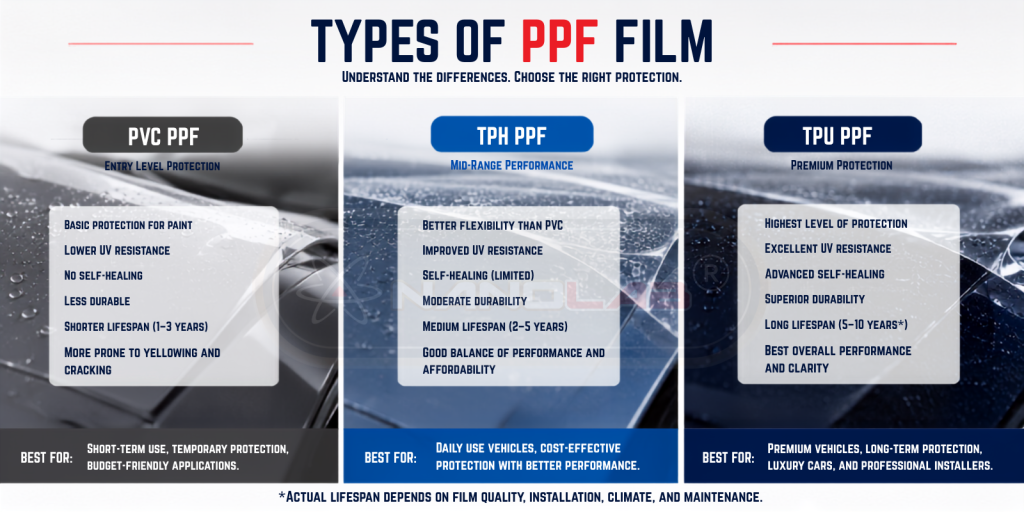
Comparison of PPF Types
| Type | Durability | UV Resistance | Self-Healing | Optical Clarity | Flexibility | Chemical Resistance | Lifespan |
|---|---|---|---|---|---|---|---|
| PVC | Low | Low | No | Fair | Low | Low | 1–3 Years |
| TPH | Medium | Medium | Limited | Good | Medium | Medium | 2–5 Years |
| TPU | Excellent | Excellent | Yes | Excellent | Excellent | High | 5–10 Years* |
*Actual lifespan depends on film brand, quality, installation quality, climate, and maintenance.
Even Premium TPU PPF Needs Maintenance
A common misconception is: “Premium TPU PPF protects itself.”
Not exactly.
While TPU offers excellent protection, its top surface is still exposed daily to:
- Dust
- Brake dust
- Traffic film
- Bird droppings
- Acid rain
- Road tar
- Water minerals
- UV radiation
Over time these contaminants reduce:
- Hydrophobic performance
- Surface smoothness
- Gloss
- Self-cleaning capability
Without regular maintenance, even premium PPF gradually loses its showroom appearance.
Why Water Coating Is Important for PPF
A water coating acts as an additional sacrificial protective layer on top of the Paint Protection Film.
Rather than replacing the PPF, it enhances its everyday performance.
Applying a professional water coating after washing helps:
- Increase water repellency
- Reduce dirt adhesion
- Improve gloss
- Make drying easier
- Preserve the original top coat
- Simplify future maintenance
This is particularly beneficial for vehicles that receive frequent maintenance washes.
Why Car Wash Shops and Detailing Centres Should Recommend Water Coating
PPF installation is usually a one-time service. Maintenance creates recurring business.
Applying Nanolab Water Coating after each maintenance wash helps:
- Restore hydrophobic performance
- Refresh gloss
- Improve slickness
- Reduce contamination build-up
- Extend the premium appearance of the film
Customers notice immediate improvements after every maintenance visit.
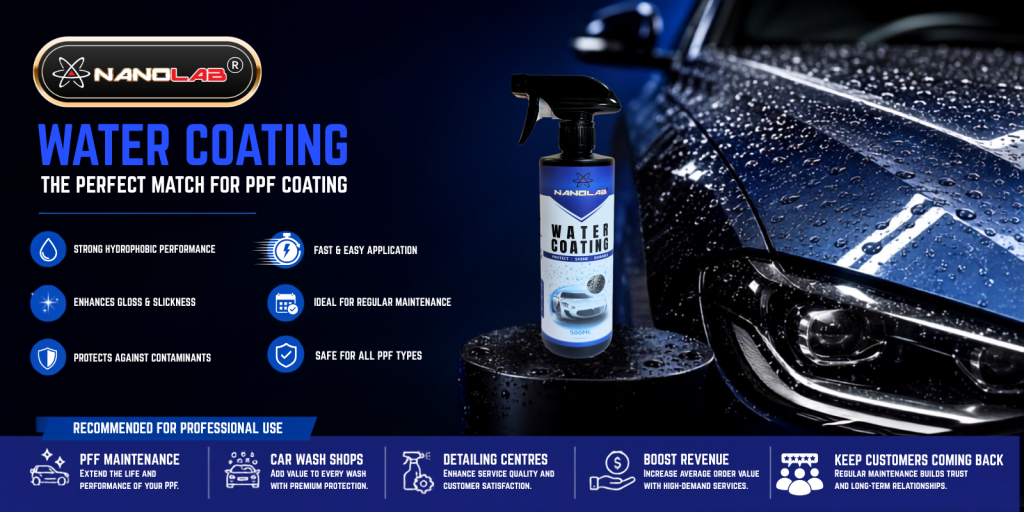
Why Nanolab Water Coating Is an Excellent Choice for PPF
A high-quality water coating should do more than simply add shine. It should support long-term maintenance without interfering with the film itself. Nanolab Water Coating is particularly suitable because it provides:
Excellent Hydrophobic Performance
Water beads and sheets away quickly, reducing water spotting while helping the PPF stay cleaner between washes.
Gloss Enhancement
Restores the deep, freshly installed appearance of gloss PPF while maintaining excellent visual clarity.
Easier Maintenance
A slicker surface means dirt, road grime, and traffic film are less likely to bond tightly to the PPF.
Fast Application
Unlike ceramic coatings that require longer installation and curing times, Nanolab Water Coating can be applied efficiently after a maintenance wash, making it ideal for busy car wash and detailing operations.
Suitable for Regular Maintenance
Frequent application helps maintain the protective top layer of the PPF without adding unnecessary complexity to the washing process.
For businesses, this creates an additional premium service that customers can enjoy during routine maintenance visits.
Why PPF Owners Benefit from Water Coating
Most PPF owners have already invested significantly in protecting their vehicle.
Applying water coating regularly helps maximise that investment by:
- Maintaining showroom gloss
- Preserving hydrophobic performance
- Making routine washing easier
- Helping reduce contamination build-up
- Keeping the vehicle cleaner for longer
Rather than waiting until the film appears dull, proactive maintenance keeps the vehicle looking its best throughout the life of the PPF.
Business Opportunity for Car Wash & Detailing Shops
As more vehicles in Malaysia adopt Paint Protection Film, businesses that combine PPF-safe washing with Nanolab Water Coating will be well positioned to deliver better results, improve customer satisfaction, and stand out in an increasingly competitive car care industry.