

Comparing Malaysia’s RON95, RON97 and Diesel with the U.S, Europe, Japan, Korea and China
Fuel prices have been one of the biggest consumer pain points in April 2026. The short version is that global oil prices surged earlier this month on a Middle East supply shock, then eased somewhat in mid-April as markets began pricing in possible de-escalation. That means the story this month is not a straight line up, but a sharp spike followed by only partial relief.
For Malaysia, the latest official weekly prices for 16–22 April 2026 are RON95 at RM4.02/litre, RON97 at RM5.10/litre, and Peninsular diesel at RM5.97/litre, while subsidised BUDI95 remains RM1.99/litre. Just one week earlier, Malaysia’s official prices were much higher, showing how quickly the global shock fed into local pump prices.
A fair comparison first
Before comparing countries, one important note: fuel grades are not labeled the same everywhere. Malaysia uses RON95 and RON97. Much of Europe commonly sells 95 and 98 RON, the U.S. uses AKI ratings instead of RON, and Japan, Korea and China often publish broader gasoline averages rather than a direct 95/97 split. So the cleanest international comparison is mainstream gasoline and diesel, with Malaysia’s RON95 and RON97 shown alongside that context.
Price snapshot: Malaysia vs major markets
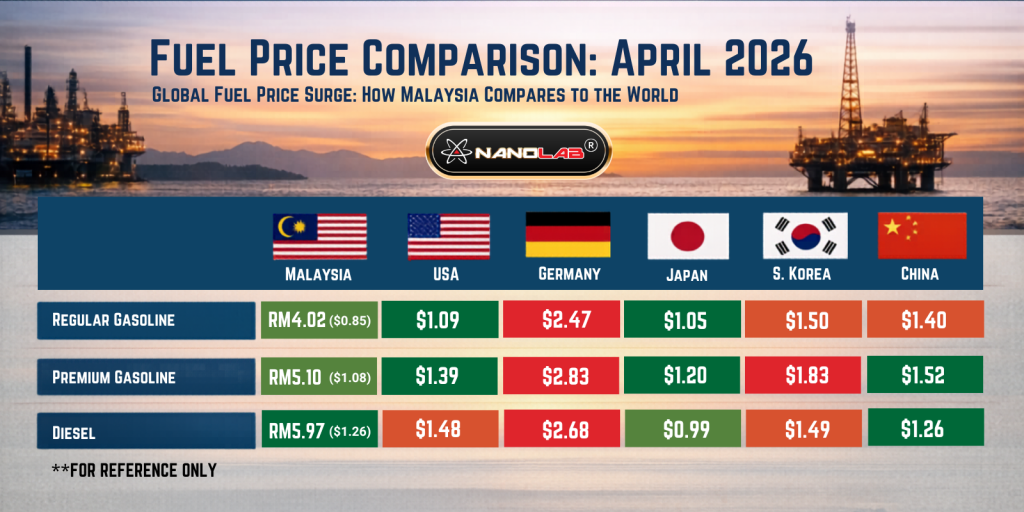
Using the latest available April 2026 data, the U.S. was at about $1.09/litre for regular gasoline and $1.48/litre for diesel. Japan was around $1.05/litre for gasoline and $0.99/litre for diesel. South Korea was roughly $1.50/litre for gasoline and $1.49/litre for diesel. China was around $1.40/litre for gasoline and $1.26/litre for diesel.
“Europe” is not one pump-price market, so the best way to represent it is with large benchmark countries. In Germany, gasoline was about $2.47/litre and diesel $2.68/litre. In France, gasoline was about $2.35/litre and diesel $2.73/litre. In the UK, gasoline was around $2.14/litre and diesel $2.61/litre. That makes European retail fuel clearly more expensive than the U.S., Japan, China and, generally, Malaysia.
Malaysia therefore sits in an unusual position. Its RON97 is expensive in local terms, but internationally, Malaysia’s gasoline has still been buffered by policy compared with many European markets. Diesel in Peninsular Malaysia spiked sharply during the April shock, then was cut again in the latest official revision, showing how strongly Malaysia’s weekly price-setting mechanism is reacting to global conditions.
Why oil prices rose so sharply in April 2026
The biggest reason was the Middle East supply shock, especially the disruption around the Strait of Hormuz, a route that handles roughly a fifth of global oil and gas flows. Reuters reported that oil prices jumped back above $100 a barrel after U.S.-Iran talks broke down and shipping disruptions intensified, while later reporting showed Brent slipping back below $100 only after hopes of renewed talks emerged.
The second reason was actual physical damage and transport disruption, not just market fear. Reuters reported attacks that cut Saudi oil production capacity by about 600,000 barrels per day and reduced throughput on the East-West Pipeline by about 700,000 barrels per day. When traders see both shipping risk and infrastructure damage at the same time, pump prices tend to react quickly because refiners and fuel distributors start paying more for replacement supply.
The third reason was regional dependence on Middle Eastern crude, especially in Asia. Japan still depends heavily on the Middle East for oil, and Reuters reported Japanese manufacturers’ confidence fell sharply as higher oil prices and supply disruption hit sentiment. South Korea also reported its sharpest import-price increase in more than three years, with crude oil prices in the import index surging dramatically in March.
The fourth reason was refining and product bottlenecks. Even when crude is available, the retail price of petrol and diesel can stay high if refineries are squeezed or if fuel production cannot respond fast enough. Reuters reported that European refining margins turned negative because crude costs rose faster than fuel prices, while U.S. Gulf Coast and Singapore margins stayed stronger. In practice, that means the pump price can remain high even after crude futures cool, because the system is still absorbing the earlier shock.
Why pump prices do not fall immediately when oil pulls back
This is a point many drivers notice. Even after crude stopped climbing, fuel prices in some markets stayed elevated. In the U.S., AAA and Reuters-linked reporting showed retail gasoline remained high well after crude had started to ease, because pump prices lag wholesale markets and because diesel and gasoline inventories, freight costs, and refining margins do not reset overnight.
Malaysia shows the same pattern, although policy changes can make the weekly moves look more abrupt. The Ministry of Finance explicitly tied its April retail adjustments to the rise in global oil prices, then lowered prices again when conditions improved. That means Malaysian consumers are seeing a combination of global oil-market pass-through plus domestic policy smoothing.
So is oil still “increasing” right now?
The accurate answer on April 2026 is: oil surged earlier in April, but by mid-April it had eased from the peak as traders reacted to possible peace talks. However, retail fuel prices are still high in many countries because the earlier shock was severe, and retail markets adjust more slowly than crude futures do.
If you compare Malaysia with the U.S, Japan, Korea, China and major European markets, the April 2026 fuel story is clear. Malaysia was hit by the same global oil shock, but its official weekly pricing and subsidy structure softened the impact relative to Europe. The main driver of the April spike was not normal seasonal demand. It was a geopolitical supply shock: disruption around Hormuz, damage to regional energy infrastructure, tighter crude availability, and refinery stress. Prices have eased somewhat in the last few days, but the global fuel market is still fragile
petrol #fuel #fuelprice #fuelprices #gasoline #diesel #ron95 #ron97 #petrolprice #oilprice #crudeoil #fuelcost #petrolstation #gasstation #fuelmarket #energyprices #petrolnews #fuelupdate #petrolmalaysia #malaysiafuel #malaysiapetrol #malaysiacar #car #cars #carowner #carowners #newcar #usedcar #carmaintenance #carcare #carwash #detailing #autocare #automotive #automobile